
More Melbourne homeowners are asking about three-phase power than ever, and it’s not hard to see why. Ducted air conditioning, an induction cooktop, a heat pump, an EV in the garage and a pool pump out the back is a very different load from what these houses were wired for.
Here’s what three-phase power actually is, how to tell whether you already have it, and when it’s genuinely worth doing.
What is 3 phase power?
Single-phase power delivers electricity down one live conductor. Three-phase delivers it down three, each one offset in timing so that as one is dipping, another is rising.
The plain-English version: instead of one supply cable feeding your house, you’ve got three. More total capacity, and a smoother, steadier delivery.
Most Australian homes are single phase, and for a house with a gas cooktop, a split system and normal appliances, that’s completely adequate. Three phase becomes relevant when the demand goes up — or when it’s about to.
How to tell if you already have it
Look at your switchboard. A single-phase home has one main switch. A three-phase home typically has three main switches side by side, or a single larger main switch fed by three fuses. If you’re looking at three of something where you expected one, that’s a good sign.
Check your meter. Three-phase meters are usually physically larger and will show three sets of connections.
Ask your distributor. United Energy, AusNet, Jemena or Citipower — depending on where in Melbourne you are — can confirm what’s connected to your property.
Or ask us. Send us a photo of your board and we’ll tell you in about thirty seconds. No charge, no obligation.
A useful clue: if your lights dim noticeably when the air conditioner kicks in, or breakers trip when a few big appliances run at once, your supply is working near its limit.
What three phase actually gives you
Capacity. The obvious one. Three phases means substantially more power available, which matters when you’re running ducted air conditioning, an EV charger, a pool heater and an induction cooktop that all want to run at six on a January evening.
Faster EV charging. This is the single biggest driver we see now. A three-phase wall charger gets you to 11 kW where single phase caps at about 7 kW — roughly 75 km of range per hour instead of 45.
Better solar performance. If you have a solar system above about 5 kW, a three-phase inverter spreads generation across all three phases rather than pushing it all down one. That reduces voltage rise, which is the usual reason inverters throttle back on sunny days.
Balanced load. Heavy circuits can be distributed across phases rather than piled onto one, which is the difference between a system that’s comfortable and one that’s always near the edge.
Room to move. Once three phase is at the property, adding capacity later is a switchboard exercise rather than a service upgrade. If you’re planning to electrify the house over the next few years, that matters.
It runs three-phase equipment. Larger ducted air conditioning, workshop machinery, commercial-grade kitchen equipment — some of it simply won’t run on single phase.
Where it’s used
Commercial and industrial — near-universally. Factories, warehouses, offices and hospitality venues run three phase for machinery, HVAC and lighting loads. If you’re fitting out a space, see our commercial electrical services.
Residential — historically uncommon, increasingly less so. Larger homes, homes with pools, and homes going all-electric are the main candidates.
Worth knowing: three-phase supply runs down most Melbourne streets already. Whether it comes into your property is a separate question, and usually one the homeowner has to initiate.
What’s involved in upgrading
The supply. If three phase isn’t already at the property, your distributor has to bring it in. Depending on where the street supply sits and how your service runs, this can be straightforward or it can involve new mains from the pole.
The meter and mains. You’ll typically need a new meter and new consumer mains, which means a meter panel upgrade.
The switchboard. Almost always a full switchboard upgrade to a three-phase board with proper RCD protection across circuits.
Older homes. In the period homes through Hawthorn, Kew and Camberwell, the existing wiring is often the real question. There’s little point feeding three phases into a board that then distributes through 1960s cable.
Compliance. All of it has to meet AS/NZS 3000 and be done by a licensed electrician, with a Certificate of Electrical Safety issued.
Cost. It varies enormously depending on how far the supply has to come and what state the existing installation is in. We won’t quote a figure here because any number we gave you would be wrong for most properties. What we will do is look at your specific situation and give you a real one.
Do you actually need it?
Honestly? A lot of homes that ask about three phase don’t need it. Frequently the real problem is a tired switchboard, an overloaded circuit, or a solar inverter that’s oversized for a single-phase connection — all of which are cheaper to fix directly.
Where it genuinely earns its keep is: two EVs, a large all-electric home, ducted air conditioning plus a pool, a serious workshop, or a renovation where you’re opening things up anyway and want to future-proof.
We’ll tell you which category you’re in, including when the answer is “you don’t need this.”
Talk to us
Registered Master Electrician, over 200 five-star Google reviews, lifetime workmanship warranty, and we work across Melbourne’s eastern suburbs from our base in Hawthorn.
If you’re weighing up three-phase power installation, send us a photo of your switchboard and get in touch. We’ll give you a straight answer.
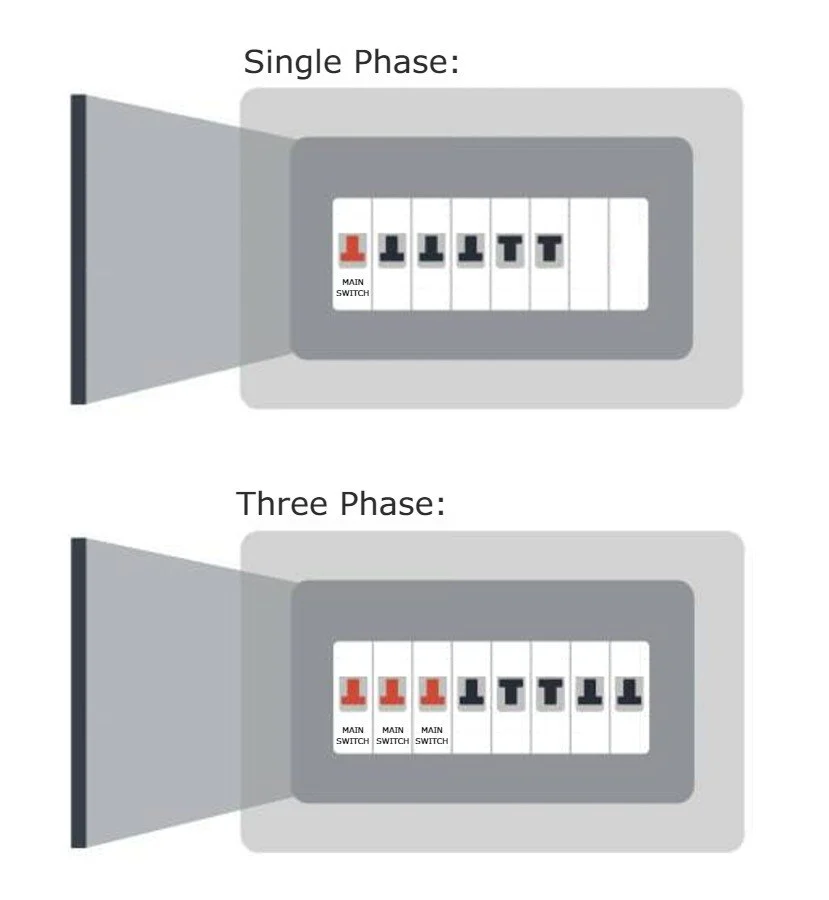
- Consult your electricity provider: Your utility company can confirm your current setup if you’re unsure.
- Ask us! Give us a call and we can help work out whether you have single phase or 3 phase power to your home or business.
💡 Pro tip: If your lights flicker when running multiple appliances, it might be a sign that your current system could benefit from an upgrade to 3-phase power.
3. The Benefits of 3-Phase Power 🌟
There are several reasons why 3-phase power is a popular choice:
Reliable Power Flow: Three-phase systems provide a steady and uninterrupted supply of electricity, making them ideal for running large appliances and equipment without running out of power.
Greater Power Capacity: Perfect for high-demand households and businesses, 3-phase power effortlessly handles heavy-duty devices such as large air conditioners, electric vehicle chargers, and pool heating systems. As we make the switch to use more and more electrical appliances this is critical.
Optimised Solar Energy Use: For solar systems over 5kW, a three-phase inverter evenly distributes energy across all phases, preventing overload and enhancing overall efficiency.
Versatile Appliance Support: With the ability to power both single-phase and three-phase devices, 3-phase power offers exceptional flexibility for homes and businesses with varying energy requirements.
Balanced Energy Distribution: By spreading power evenly across three wires, 3-phase systems reduce the chance of overloading a single phase, creating a stable and balanced setup.
Ready for Future Needs: Planning to upgrade your solar system or add more appliances? A 3-phase system makes these upgrades easier, ensuring your power supply can grow alongside your needs.
This advanced setup is a forward-thinking solution for efficient and reliable energy management.
If you’re running a high-energy household or workshop, this efficiency can save you from the frustration of tripped breakers or overloaded circuits.
4. Applications of 3-Phase Power 🏭
Where does 3-phase power shine?
- Industrial and commercial settings: Factories, warehouses, and office buildings rely on 3-phase power to run machinery, lighting, and HVAC systems.
- Residential use: While single phase dominates homes at the moment, more and more households are switching to 3-phase power as they add pools, high-capacity HVAC systems, or electric vehicle chargers.
💡 Fun fact: Many Australian suburbs offer access to 3-phase power, but it’s often up to the homeowner to request installation.
5. Key Considerations for 3-Phase Power Installation ⚙️
Thinking of making the switch? Here’s what to keep in mind:
- Costs: Upgrading to 3-phase power involves installation fees, additional wiring, and potential appliance upgrades. Prices can vary but it can cost around $6,000 to install 3-phase power.
- Technical requirements: Your property must have the infrastructure to support 3-phase power. Older homes might need significant rewiring.
- Australian regulations: Installation must comply with local electrical standards, so hiring a licensed electrician is essential.
- When to upgrade: If you’re installing energy-hungry appliances or experiencing frequent power issues, it may be time to consider 3-phase power.
At Luno Electrical, we make this process seamless, ensuring your home or business gets the power it needs without a hitch. If you’d like to discuss 3-phase power for your home or office contact us for a free quote.
Conclusion
3-phase power isn’t just for factories; it’s a versatile and efficient system that can benefit homes, businesses, and industrial operations alike. Here are the top 5 takeaways:
- Understand the basics of 3-phase power and how it works.
- Learn how to identify whether your home already has it.
- Appreciate the efficiency, cost-effectiveness, and performance benefits.
- Explore its applications in residential and commercial settings.
- Consider the costs and requirements for installation.
Ready to take your power system to the next level? Contact Luno Electrical today for expert advice and installation services. With a 5 star Google rating we’re here to help you make the switch, stress-free! 💡✨