Electrical faults don’t wait for a convenient moment. One minute you’re getting dinner on, the next you’re standing in the kitchen trying to work out whether that burning smell is something you call about right now, or something that can wait until Monday. That uncertainty is the real problem. Wait too long and you’re risking your home and the people in it. Call out an electrician for every flickering globe and you’re spending money you didn’t need to spend. So here’s the framework we use. It’s the same one we’d give a mate over the fence. The three-tier rule Every ...
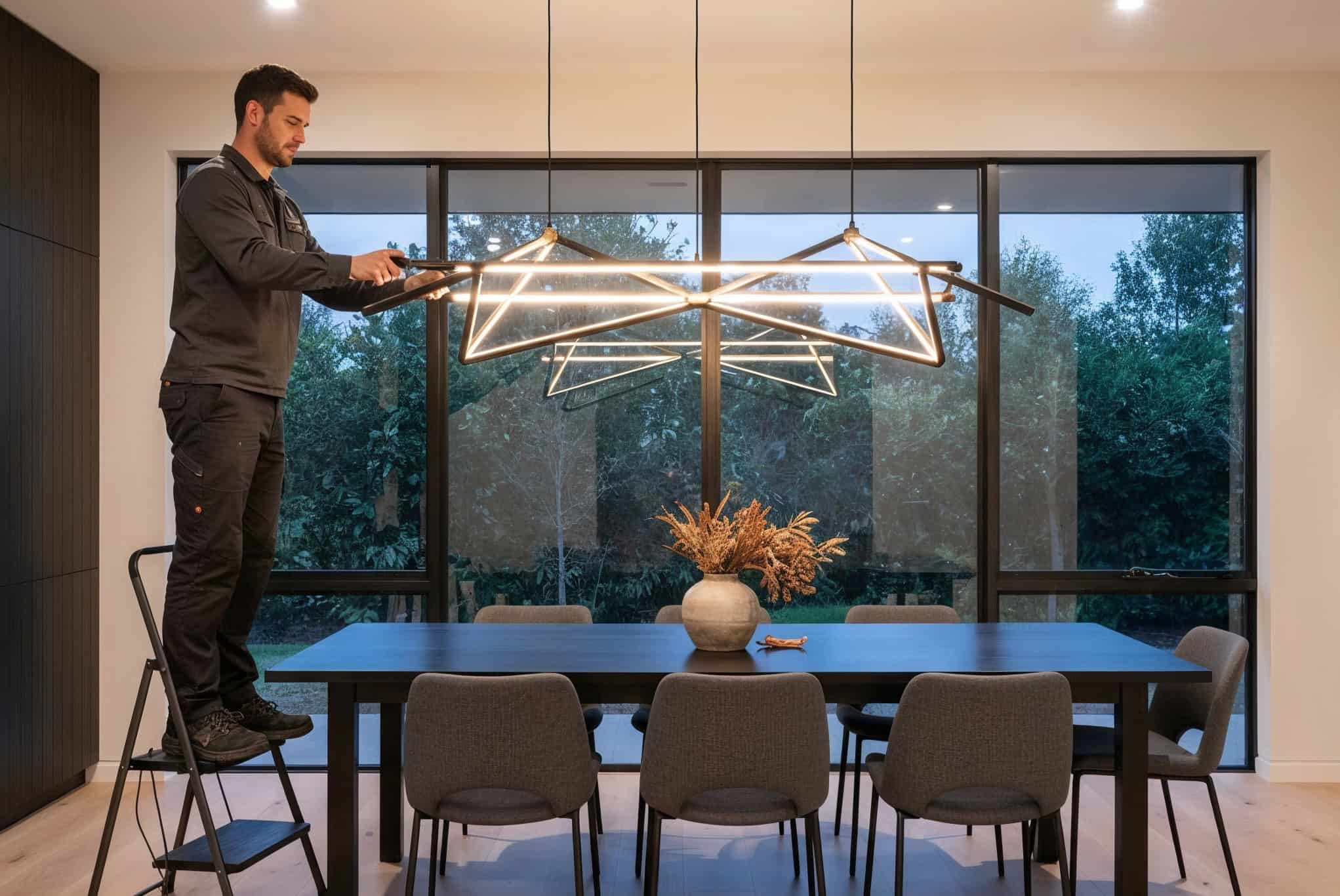
You’ve found the light. It’s perfect — right shape, right finish, right price, and you can already see it hanging over the dining table. Before you buy it, check one thing: can it actually be installed where you want it, and will it work with what’s already there? That sounds obvious. It’s the single most common reason we turn up to install a fitting and can’t. The one thing: dimmer compatibility If the light is going on a dimmer — and most people want dimmers — this is the check that matters. LED lights and dimmers are frequently incompatible, and ...
Sensor lighting is one of the few security measures that’s genuinely worth what it costs. It’s cheap, it doesn’t require a subscription, and the deterrent effect is real — most opportunistic intruders are looking for a house where nobody will notice them. The difference between sensor lighting that works and sensor lighting that annoys everyone in the street comes down almost entirely to positioning and setup. Here’s how to get it right. Where lights actually need to go Think about how someone approaches a house, not about where it’s convenient to run a cable. The front entry. The obvious one, ...
There’s a version of this article that’s all jokes about getting zapped. We’ve written enough of those. Here’s the version that’s actually useful: what the law says, what your insurer says, and where the line sits between sensible self-reliance and a genuinely bad idea. What you can legally do yourself in Victoria Shorter list than most people expect. You can: replace a light globe, replace a fuse wire in an old-style ceramic fuse carrier, reset a tripped circuit breaker or RCD, plug in and unplug appliances, and replace a plug-in appliance’s own flexible cord if you’re competent — though even ...
Why did the solar panel break up with the electricity bill? Because it was tired of all the charges! Solar panel installation is lighting up Melbourne homes faster than you can say “renewable energy.” Although we always complain about Melbourne weather, we still have abundant sunshine and generous rebates so there’s never been a better time to make the switch. But before you jump on the solar bandwagon, there are six crucial things every Melbourne homeowner must know. At Luno Electrical, we’re your local master electricians with over 170 five-star Google reviews who are always on time and always clean ...
The lights turn on. The power points work. The agent says the building’s been well maintained. None of that tells you whether the electrical installation can support your business, or what it’ll cost you to make it. Commercial leases in Victoria routinely put the cost of the electrical installation on the tenant — through make-good obligations, repair covenants, or simply the practical reality that if it doesn’t work you can’t trade. By the time you find out, you’ve signed. Here’s what to check before that happens. What tenants actually inherit Three categories of nasty surprise, in rough order of how ...
Every renovation has a moment where someone realises the pendant is directly above where your head goes when you stand up from the dining table. Or that there’s no outlet on the island. Or that the TV point is 400mm from where the TV ended up. None of these are expensive to get right at planning stage. All of them are expensive to fix afterwards. Here’s what to sort out before the walls close. 1. Decide where you’ll stand, not where the room’s centre is Most electrical plans are drawn symmetrically, because symmetry looks right on a drawing. Then people ...
Choosing a commercial electrician is a different exercise from choosing one for your house. The stakes are different, the compliance obligations are different, and the cost of getting it wrong isn’t an inconvenience — it’s downtime, staff standing around, and in a bad case, liability. This guide covers what commercial electrical work actually involves in Melbourne, what your obligations are, and how to tell a contractor who’ll be there in three years from one who won’t. What a commercial electrician actually does The trade is the same. The context isn’t. Commercial electrical work covers three-phase distribution, larger switchboards and sub-boards, ...
Almost every electrical failure we attend in a commercial building was preventable, and most of them were visible months earlier to anyone who went looking. The buildings that don’t have these problems aren’t lucky. They’re running a schedule. Here’s the schedule. The compliance non-negotiables Start here, because these are legal obligations rather than good practice. Emergency and exit lighting — every 6 months Under AS 2293.2, emergency and exit lighting must be tested every six months. The test is a 90-minute discharge — the fittings run on battery for the full duration to prove they’d actually work in an evacuation. ...
Most advice about blue light and sleep is either a supplement advertisement or a lecture about screen time. Here’s the version from people who install lighting for a living. The short of it: your evening lighting probably matters more than your phone does, and it’s easier to fix. What’s actually going on Your body runs on a roughly 24-hour cycle, and light is the main thing that sets it. Specialised receptors in your eyes — separate from the ones you see with — are most sensitive to blue wavelengths, around 480 nanometres. When they detect that light, they tell your ...
The electrical problems that cause real damage are almost never the ones you can see. A dead power point announces itself. A breaker that trips gets your attention. But the faults that start fires have usually been developing quietly for years behind plaster, above ceilings and inside walls, and there’s nothing in the house to tell you. Here are five we find regularly in Melbourne homes that looked completely fine from the inside. 1. Perished rubber-insulated cable Homes wired between roughly the 1930s and 1960s used rubber-insulated cable, often with a cotton braid over it. Rubber has a service life, ...
Battery rebates in Australia have changed more than once in the past eighteen months, and most of what’s written about them online is out of date within a quarter. So rather than quote a figure that’ll be wrong by Christmas, here’s how the support actually works, what’s currently available in Victoria, and how to check the current number yourself. The short version There is no Victorian state battery rebate. Solar Victoria’s Solar Homes battery loan has closed to new applications and has not been replaced. There is a federal rebate, the Cheaper Home Batteries Program, and it’s substantial — roughly ...
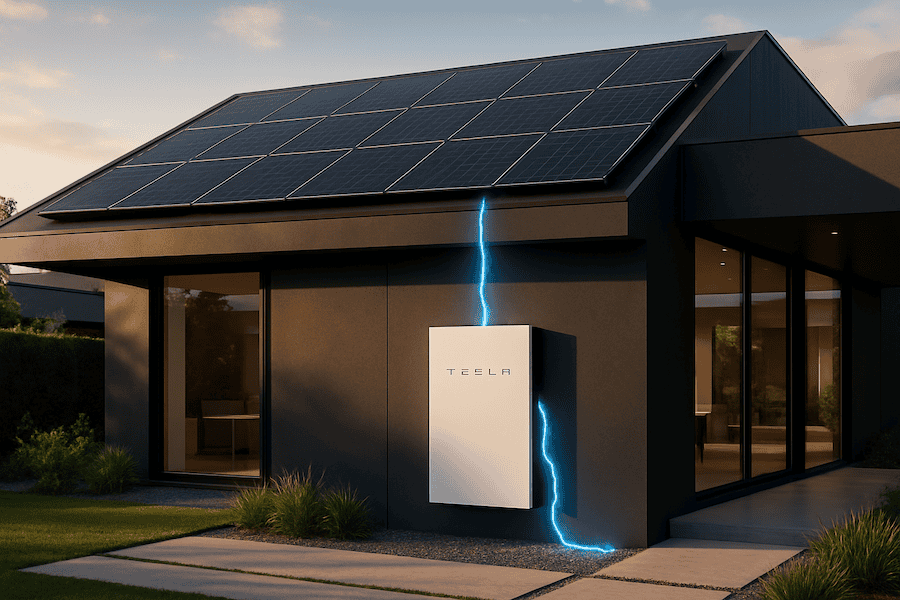
Batteries have gone from a niche purchase to something we get asked about most weeks. The technology has settled down, the federal rebate has made the numbers work for a lot more households, and electricity prices have done what electricity prices do. Here’s the honest version: what a battery does, what it costs you, and who it actually suits. What a home battery does Solar panels generate during the day. Most households use most of their electricity in the morning and evening. Without storage, you export your cheap daytime generation to the grid for a small feed-in tariff and buy ...
I do a lot of electrical safety checks. Most of them are on homes that look completely fine — nice houses, well kept, nothing obviously wrong. That’s rather the point. Almost nothing that matters is visible from the living room. Here’s what I actually find, in roughly the order I find it. — Andrew Vaiano, Registered Master Electrician (REC 25989) Smoke alarms past their date This is the most common thing I find, and it’s the easiest to fix. Photoelectric smoke alarms have a ten-year service life. Not the battery — the unit. The sensing element degrades, and after a ...
You’ve got the car. Now you need to work out how to put electricity into it at home without tripping the house or spending more than the car cost you. The good news is there are only really five options, and picking between them comes down to two questions: how many kilometres do you actually drive in a day, and how many hours is the car parked at home? Here’s each one, honestly, including where it falls down. Driving a Tesla? We’ve got a separate guide to Tesla home charging. And if you want to know what it’ll cost to ...
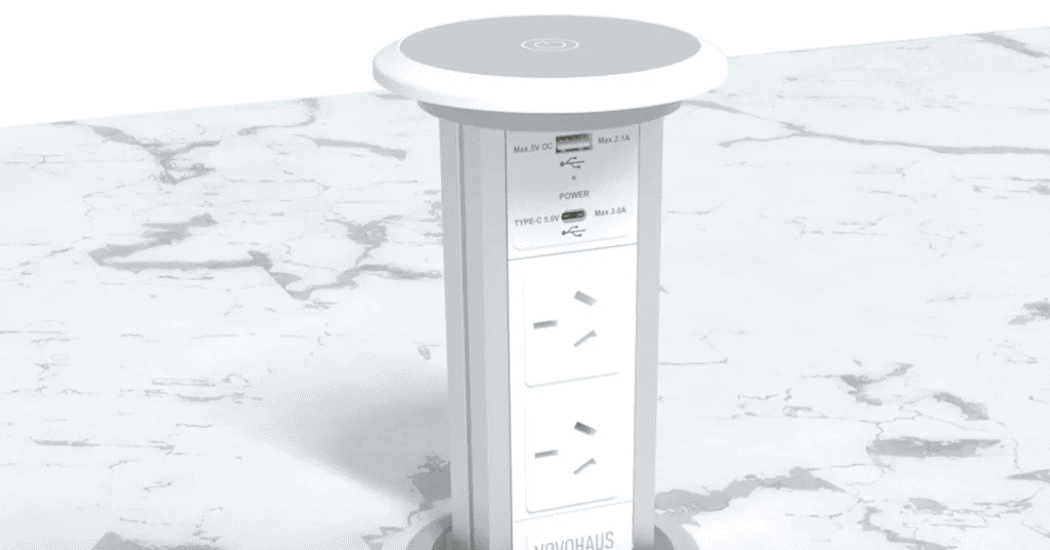
USB power points are one of those upgrades that seems trivial until you’ve lived with them, at which point the bedside table with a wall wart hanging out of it starts to look genuinely annoying. They’re also one of the easiest ways to get sold something that’ll be obsolete in three years. Here’s what actually matters. Get the USB-C question right first This is the whole ball game, and plenty of outlets still on shelves get it wrong. USB-A is the original rectangular port. It’s fine for older accessories and it’s on its way out. USB-C is the reversible oval ...
There’s a government scheme in Victoria that will substantially discount a heat pump hot water system or a new reverse-cycle air conditioner, and a surprising number of households have never heard of it. It’s called Victorian Energy Upgrades. Here’s how it works, without the sales pitch that usually surrounds it. What it is VEU is a Victorian government energy efficiency scheme. It works by requiring energy retailers to fund efficiency improvements, which they do by creating certificates when someone upgrades an inefficient appliance to an efficient one. The value of those certificates is passed to you as a discount at ...
More Melbourne homeowners are asking about three-phase power than ever, and it’s not hard to see why. Ducted air conditioning, an induction cooktop, a heat pump, an EV in the garage and a pool pump out the back is a very different load from what these houses were wired for. Here’s what three-phase power actually is, how to tell whether you already have it, and when it’s genuinely worth doing. What is 3 phase power? Single-phase power delivers electricity down one live conductor. Three-phase delivers it down three, each one offset in timing so that as one is dipping, another ...
Split system air conditioning units are a must-have for many Australian homes, providing efficient cooling in the summer and cosy heating during winter. As electricians, we frequently get asked specific questions about how to choose the right system, the costs involved, and how to maintain it. Below are the top five questions we hear about split system installations, and our answers to help you make informed decisions for your home. Remember, feel free to call us anytime for a chat or get a free quote. 1.What size system do I need for my room? Choosing the correct size split ...
Ceiling fans are one of the best value things you can put in a Melbourne home. They cost a few cents a day to run, they make a room usable on a 30-degree night without the air conditioner working as hard, and in winter, reversed, they push warm air back down off the ceiling. Here are the six questions we get asked most often when we’re quoting ceiling fan installation. 1. Do I need an electrician to install a ceiling fan? Yes. In Victoria, connecting a ceiling fan to your home’s wiring is electrical work, and electrical work must be ...
Most kitchen lighting fails the same way: a grid of downlights across the ceiling, all one brightness, all one colour, and every time you stand at the bench you’re working in your own shadow. It’s not that the lights are bad. It’s that there’s only one layer of them. Here’s how to get it right, whether you’re renovating or just tired of the one you’ve got. Three layers, not one Good kitchen lighting does three separate jobs, and each needs its own layer. Ambient — the general light that fills the room. This is what your ceiling downlights are for, ...
Extraction is the least interesting part of a kitchen or bathroom, and the part people notice most when it’s wrong. Steam on the mirror, mould in the corner of the ceiling, and a house that smells like last night’s dinner at breakfast. The good news is that getting it right isn’t complicated. It just has to be sized properly and vented somewhere sensible. Ducted or recirculating? Duct it. This is the decision that matters most, and it’s the one most often got wrong. Ducted rangehoods and exhaust fans move air outside the building. The moisture, grease and odour leave. Recirculating ...
Going all-electric has stopped being an ideological decision and become an arithmetic one. Gas supply charges apply whether you use gas or not, reverse-cycle heating is cheaper to run than gas heating, and induction cooking has quietly won over most of the people who swore they’d never give up a flame. But there’s an order to doing this, and getting the order wrong is expensive. Here’s how we’d approach it. Do the electrical infrastructure first This is the single most important thing in this article. Every gas appliance you replace adds electrical load. Induction cooktop, heat pump hot water, reverse-cycle ...
The power goes out. Or worse, it half goes out — the lights dim, the fridge makes a noise it doesn’t normally make, and everything feels slightly wrong. Knowing which one you’re dealing with matters, because one of them is the network’s problem and the other might be yours. Blackout: the power is off A complete loss of supply. Straightforward to identify, if not to enjoy. Causes: storm damage to overhead lines, equipment failure at the substation, a car into a pole, planned maintenance, or load shedding on extreme demand days. First thing to check: is it just you? Look ...
A power point that’s stopped working is one of those problems that’s either trivially simple or genuinely serious, with not much in between. Here’s how to tell which one you’ve got — and the two-minute check that solves it about a third of the time. Start here: the two-minute check Before anything else: Test the appliance somewhere else. Sounds obvious. Solves this more often than you’d expect. Check the switch on the outlet. Also obvious. Also frequently the answer. Check your switchboard. Look for a tripped breaker or safety switch — a switch sitting between on and off, or clearly ...
We’ve been working on Melbourne homes long enough to know that the same handful of problems come up again and again. Different suburbs, different eras, same faults. Here are the seven we’re called to most, what actually causes each one, and — the useful bit — which ones you can safely leave until Tuesday and which ones you can’t. 1. Circuit breakers that keep tripping By far the most common call we get. A breaker trips because it’s protecting you from something: too much current on the circuit, a short circuit, or an earth fault. It is not being temperamental. ...
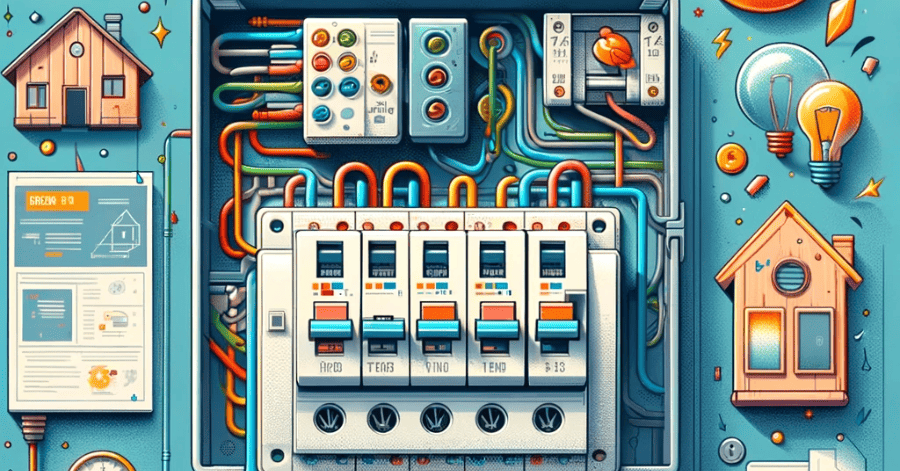
The switchboard is the one part of your electrical system that everything else depends on, and it’s the part almost nobody looks at. If yours still has ceramic fuses with fuse wire in them, or it’s a mix of old and new bolted together over thirty years, this is worth ten minutes of your time. What the switchboard actually does Three things live in that box, and they do different jobs. The main switch cuts power to the whole property. Worth knowing where it is before you need it. Circuit breakers protect the wiring. If a circuit draws more current ...
There’s a specific Melbourne experience of stepping onto a tiled bathroom floor at 6:30 on a July morning. Electric floor heating is the solution to it, and it’s one of the few upgrades people mention to us unprompted years later. Here’s an honest look at why it works, what it costs to run, and where it makes sense. 1. It heats the way you actually want to be heated Conventional heating warms air, which rises, sits at the ceiling, and leaves your feet cold. Floor heating warms the surface you’re standing on, which then radiates warmth upward through the room. ...
First thing worth saying: a breaker that trips is a breaker that’s working. It’s not being difficult. It’s doing the single job it was installed to do, which is to open the circuit before something worse happens. The question isn’t how to stop it tripping. It’s why it’s tripping. Breaker or safety switch — know which Before anything else, work out what actually tripped, because they mean different things. A circuit breaker protects the wiring from carrying more current than it safely can. It trips on overload or short circuit. It’s usually a single switch serving one circuit. An RCD, ...
You’ve ordered the car, or it’s already in the driveway, and the next question is always the same: how do I charge this thing at home? We’re a Tesla Certified Installer, which means we’ve had this conversation a few hundred times. Here’s the honest version. Want to know what it’ll cost to run? Try our Tesla home charging calculator. Driving something other than a Tesla? The EV home charging guide covers the same ground for other makes. 1. The standard power point Plug the Mobile Connector into an ordinary 10A socket. Around 2.3 kW, which is roughly 10 km of ...
An LFP (Lithium iron phosphate) battery is a type of rechargeable lithium-ion battery that uses iron phosphate as the cathode material. Unlike other lithium-ion batteries, LFP batteries do not contain cobalt or other toxic metals, making them safer, more environmentally friendly, and more durable. Advantages of LFP batteries compared to Lithium-ion batteries: Safety: LFP batteries are safer than Lithium-ion batteries, as they have a lower risk of thermal runaway, a condition in which the battery overheats and becomes a fire risk. (Argonne National Laboratory, n.d.) Longevity: LFP batteries have a longer lifespan than Lithium-ion batteries, due to their more stable ...
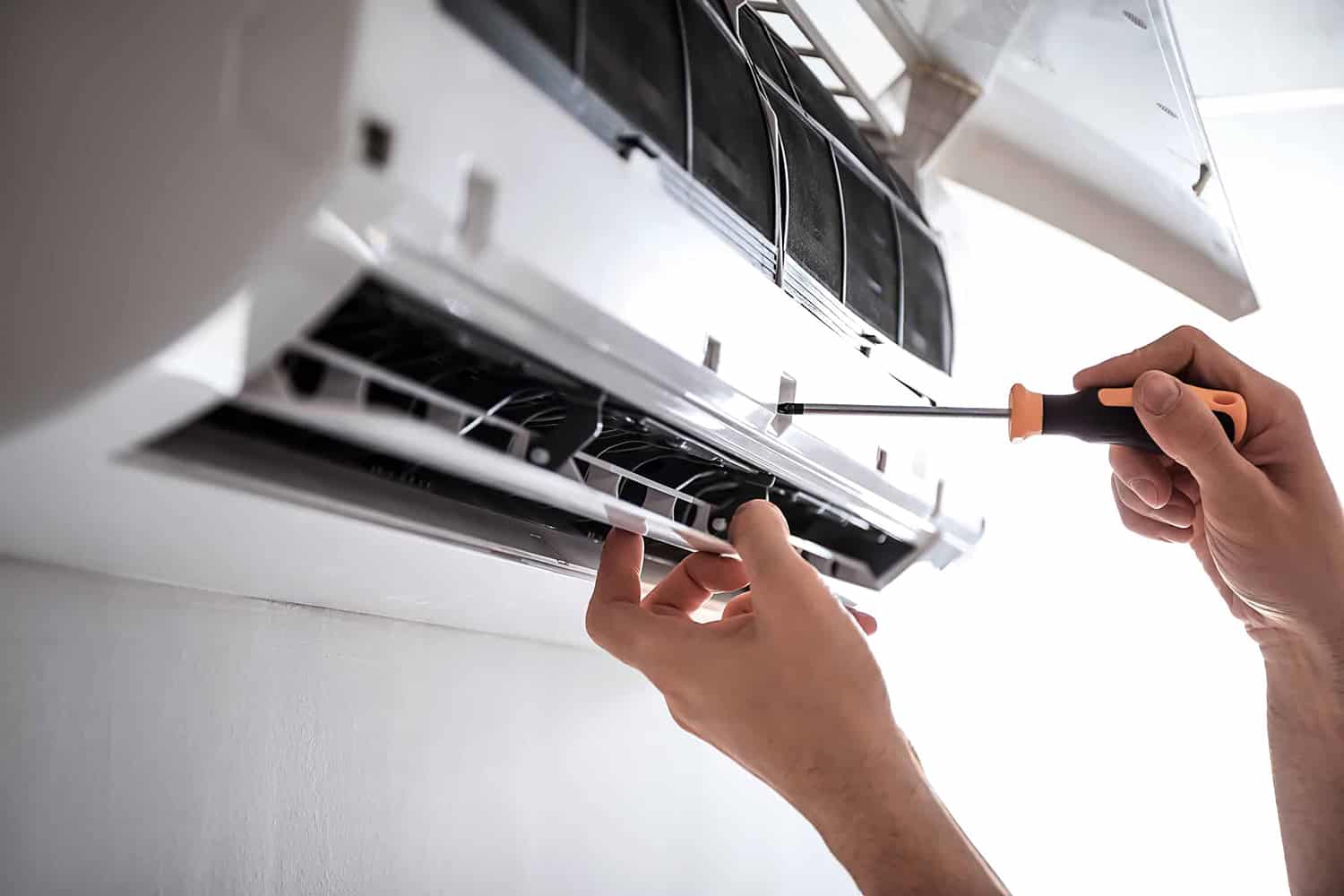
Air conditioning fails in February. Never in September, when someone could look at it calmly and order a part. Always on the third consecutive day over 38, when every technician in Melbourne is already booked. That timing isn’t bad luck. It’s the system finally being asked to do what it’s been quietly failing at for months. Here’s what actually goes wrong, and the small amount of maintenance that prevents most of it. The five things that cause most failures 1. Blocked filters and coils The most common cause by a distance, and the most preventable. A clogged filter restricts airflow. ...