First thing worth saying: a breaker that trips is a breaker that’s working. It’s not being difficult. It’s doing the single job it was installed to do, which is to open the circuit before something worse happens.
The question isn’t how to stop it tripping. It’s why it’s tripping.
Breaker or safety switch — know which
Before anything else, work out what actually tripped, because they mean different things.
A circuit breaker protects the wiring from carrying more current than it safely can. It trips on overload or short circuit. It’s usually a single switch serving one circuit.
An RCD, or safety switch, protects people. It detects current leaking to earth — the thing that happens when electricity finds a path through a person — and disconnects in around 30 milliseconds. It’ll have a test button on it, usually marked “T”.
An RCBO is both in one device, which is what we fit on most modern boards.
If your safety switch is tripping, that’s a leakage fault, and it’s a different investigation from an overload. It also means the safety switch is doing exactly what it should — which is worth remembering before anyone gets frustrated with it.
1. Circuit overload
The most common cause by a wide margin.
Too much current on one circuit. The classic version is a kitchen where the kettle, toaster and microwave all run at once, or a bedroom where a 2400W heater goes on alongside everything else.
How to tell: it trips when you add a particular appliance, and stops tripping when you don’t.
What to do: redistribute the load, and stop using power boards as a way of getting more capacity out of one outlet — they don’t. The real fix is more circuits and more outlets, which is a straightforward job.
2. A faulty appliance
Very common, and easy to find yourself.
How to isolate it: unplug everything on the affected circuit. Reset the breaker. Plug things back in one at a time, leaving a few minutes between each. The one that trips it is the one.
Heating elements are the usual offenders — kettles, toasters, dryers, dishwashers, hot water systems. As elements age, they develop small leakage to earth, which is enough to trip an RCD long before the appliance stops working. This is why an old dishwasher can trip a safety switch while still washing dishes perfectly well.
If you find the appliance, stop using it. It’s telling you something. See appliance repair and installation if it’s worth saving.
3. Moisture
Melbourne’s favourite.
Water anywhere it shouldn’t be — an outdoor power point without a proper weatherproof cover, a light fitting under a leaking roof, condensation in an external junction box, an outdoor circuit after a storm.
How to tell: it started after rain, or trips only in wet weather, and the affected circuit includes something outdoors.
What to do: this needs an electrician. Water in an electrical enclosure isn’t something to poke at, and the entry point needs finding rather than drying out.
4. A short circuit or damaged cable
Active touching neutral, or active touching earth. This trips instantly and hard, and often with a bang.
Causes: a nail or screw through a cable during renovation — we get called to this a lot after someone’s hung shelving. Pest damage in roof spaces and wall cavities. Old, brittle insulation failing. Water damage.
How to tell: it trips immediately on reset, with nothing plugged in, or it trips the moment you reset it.
What to do: stop resetting it and call. A hard short is a fault that has already failed once. If it’s accompanied by any smell, sound or heat, that’s an emergency call, not a Monday job.
If it turns out to be deteriorated wiring rather than a single damaged cable, that’s a conversation about a rewire.
5. Cumulative leakage across the circuit
The one people find most confusing.
Every appliance leaks a tiny amount of current to earth. Individually it’s nothing. But an RCD trips at around 30 milliamps total across everything on that circuit — so eight or nine appliances each leaking 3mA will trip it, with no single faulty item to find.
How to tell: it trips seemingly at random, you can’t isolate a single appliance, and it’s worse when more is running.
What to do: the fix is splitting the circuit so the load — and therefore the leakage — is distributed across more RCDs. That’s a switchboard upgrade, and it usually resolves a problem the homeowner has been living with for years.
The one thing not to do
Don’t keep resetting it.
We understand the temptation — the power’s off, it’s inconvenient, and flipping the switch makes it come back. But each reset re-energises a circuit that has already told you something is wrong, and if the fault is a short or a damaged cable, you’re re-energising it into the fault.
Reset once. If it holds, note what was running and think about load. If it trips again, or won’t reset, leave it off and call.
Also don’t fit a larger breaker. Ever. The breaker is sized to the cable, not the appliance. Uprating it means the cable will now overheat before anything trips — which is precisely the situation breakers exist to prevent.
When to call
Now: it won’t reset at all, it trips instantly with everything unplugged, or there’s any smell, heat, noise or discolouration at the board or an outlet.
This week: the same circuit trips repeatedly, your safety switch trips at random, or you can’t work out which appliance is responsible.
Whenever suits: you’ve identified an overload and you’d like more circuits so it stops happening.
Talk to us
We do fault finding across Melbourne’s eastern suburbs, and it’s some of the most satisfying work we do — tracing an intermittent fault that’s been annoying someone for months and finally putting an end to it.
Registered Master Electrician. Over 200 five-star Google reviews. Lifetime workmanship warranty.
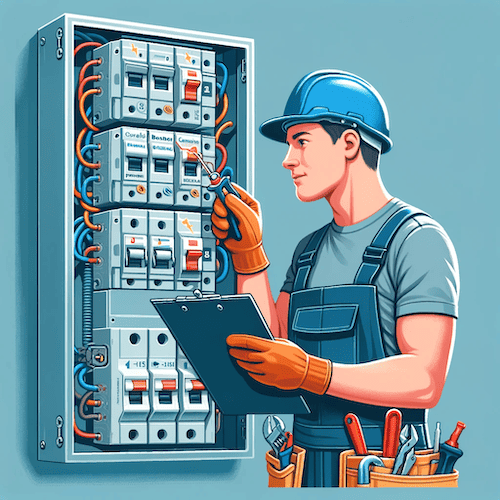
4. Earth Leakage Fault: Water + Electricity = Trouble
Residual Current Device (RCDs) are there to detect any imbalance in an electrical circuit. If even the slightest bit of moisture is detected by the RCD it will trip the circuit before it becomes a dangerous issue. If your breakers are diving more than an Olympic swimmer as a result of water, immediately call us as this needs to be fixed asap.
5. Circuit Breaker Malfunctions: It’s Not You, It’s the Breaker
Sometimes the breaker itself is the weary actor in this drama. Frequent tripping without cause? Your breaker might just need a holiday. It’s a sign to get a professional evaluation, and yes, we at Luno Electrical can be your electrical therapists.
Conclusion
From overloaded circuits, dramatic short circuits, sneaky wiring issues, to damp-situations and tired old breakers, Luno Electrical is your go-to team for solving these mysteries. With our expertise, we’ll ensure your electrical system is as reliable as a kangaroo’s hop. Need help? Hop over to our Contact Us page.
Dad Joke to Spark Some Fun
Why was the electrician calm during a blackout? Because he knew how to conduct himself!
Got a question about circuit breakers tripping?
Want to talk to an expert?
Circuit Breakers and Electrical Safety FAQs
Circuit breakers usually trip due to overloaded circuits, short circuits, earth faults, faulty appliances or wiring, and sometimes due to the breaker itself being old or damaged.
First, disconnect any recently added appliances, then reset the breaker. If it trips again or frequently, contact a licensed electrician like Luno Electrical for a professional assessment.
Yes, it's generally safe to reset a tripped breaker. However, if it keeps tripping or you notice signs of damage, it's best to consult a professional.
Avoid overloading circuits, ensure proper appliance installation, use RCDs, and consider having your electrical system inspected and upgraded by professionals like those at Luno Electrical.
A RCD is a device that protects against electric shock from faults in electrical appliances or wiring. It's especially important in areas prone to moisture, like bathrooms and kitchens.
While it can be a sign of underlying electrical problems, it's not always an emergency. However, if accompanied by a burning smell, sparks, or visible damage, it should be treated as an emergency and addressed immediately by a professional.
What our customers say